

Tenleigh Ellis, a fourth year veterinary student from the University of Missouri, discusses the importance of identification in our hoofstock herds.
What is that in that animal’s ear?
You may have seen something in the ear of some of our hoofstock as you drive through the park. Ever wonder what it is? It is an ear tag. These ear tags are similar to what you would use on cattle. It is like an earring. It has a front piece with a number on it that attaches to a back piece by going through the ear.
What are the ear tags used for?
They are used for identification. Though individual animals in a herd can have distinguishing characteristics, it is easier and more accurate to have an ear tag associated for each individual for most of our herds. This way, it is easier to train staff in how to pick each individual out of the herd and it is easier to double check who everyone is while they are moving. In addition, it makes it easier to tell if they are male or female at a glance. Males get an ear tag in their right ear and females get an ear tag in their left ear.

Why do some have an ear tag and others don’t?
It would be best if every individual in the park had an ear tag, but unfortunately that is not possible. Generally speaking, animals that do not have other obvious identifiers and are of high conservation value, are easy to hand grab as a baby, or who have undergone a medical procedure, have ear tags.
The reason why animals of high conservation value are tagged is because we want to be able to monitor the health of the herd closely and also know the genetics of each individual. If a herd is not genetically managed, like the blackbuck, then it is less of a priority to have them all identified since we don’t need to know who is related to who.
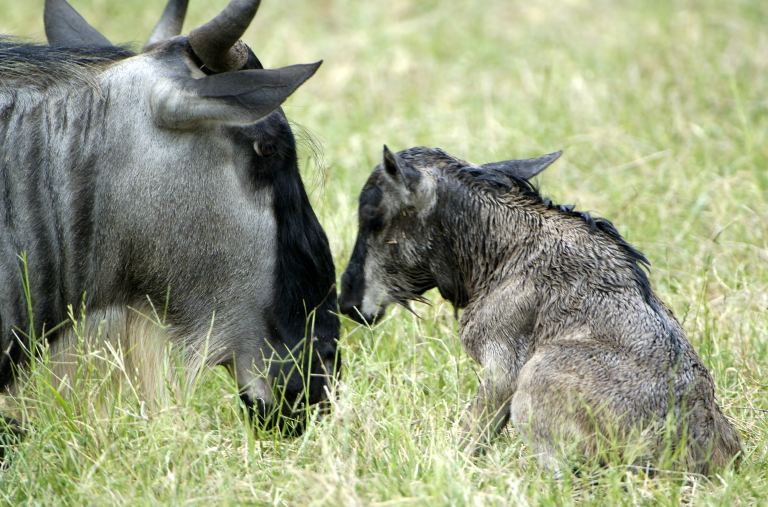
For the animals that we are able to tag when they are babies, their mothers have to leave them alone long enough for the animal care staff to be able to find them and pick them up. Some of our species like the scimitar-horned oryx do a behavior called tucking. This is when the mother finds a nice spot to leave her baby until the calf can keep up with the herd so in the wild they are less likely to catch the attention of a predator. While the moms are away the calf does their best imitation of a rock so they can be hard to find. When the animal care staff do find them we are able to do a full neonatal exam and give them an ear tag before giving them back to their mothers. Some of our other species, like the waterbuck and gemsbok, are too good at hiding their babies so most of them are not ear tagged as calves.
Once the animals get too big to safely handle, they only get an ear tag if they undergo a medical procedure or are put under anesthesia to be moved to another pasture. Anesthesia is generally safe but it is not without its risks, so we would not put an animal under anesthesia just for an ear tag. This is why when you look at the fallow deer it appears that only the males have ear tags. The fallow deer tend to be healthy so the only ones that get put under anesthesia are the males that undergo an epididymectomy procedure to prevent them from fathering any offspring while being able to keep their antlers.
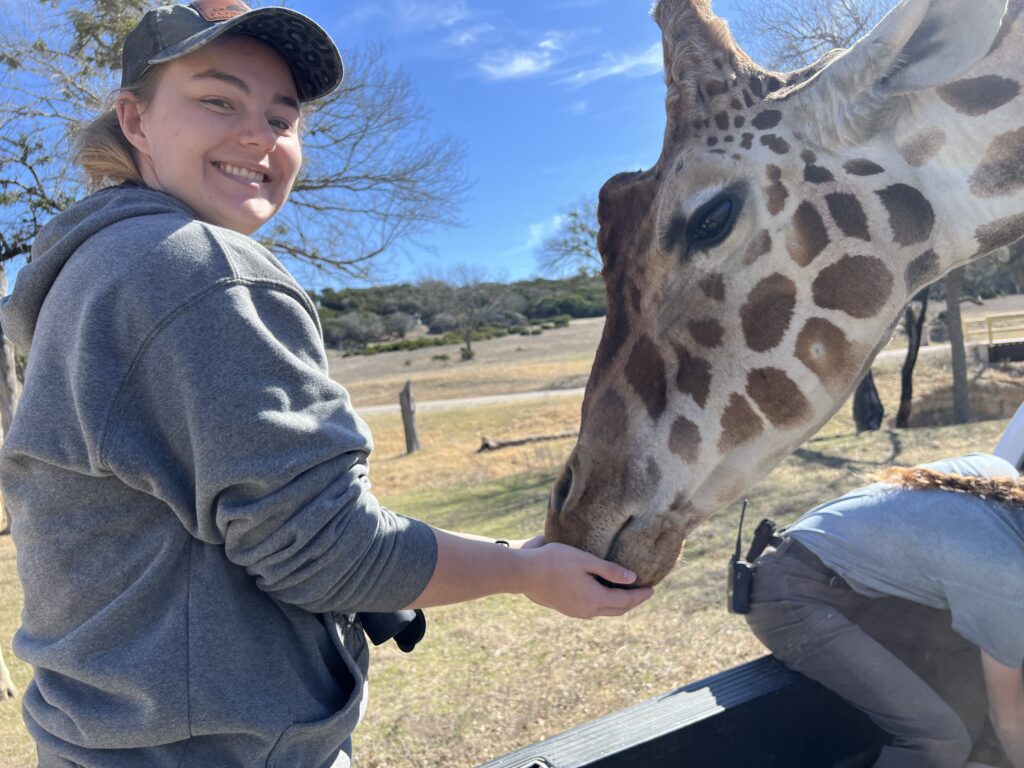
Other species like the rhinos and the giraffe are easy to tell apart so they do not need to have ear tags. Each rhino likes their horn to be shaped a specific way and rub it on things to get it to that shape and keep it that way. It is sort of like having a specific haircut you like. Since it is so unique for each rhino it is easy to tell them apart even from a distance. For giraffe, the spot pattern is distinct on each animal, also making it easy to tell them apart from a distance.